

Horizontal pressure vessels and air receivers with feet

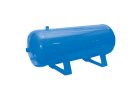
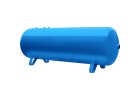
Horizontal pressure vessels and air receivers with feet from 5 to 3000 litres — 32 vessels on one page. The carbon steel vessels are rated for 11, 12 and 16 bar and are painted, with selected sizes from 270 l also galvanised or with the ALM internal coating. They are complemented by eleven stainless steel vessels in AISI304 or AISI316L steel.
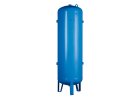
A horizontal vessel is low. It fits under a lower ceiling, a platform, a staircase or a workbench, but it needs more length than a vertical vessel of the same volume. You will find vertical vessels, cylinders without feet and the whole range in our category of pressure vessels and air receivers.
What you will find among the horizontal vessels
The table sorts the horizontal vessels by the category they come from: how many there are, in which volume range, for which pressure and with which finish. You can then pick a specific vessel in the product listing below this description.
| Horizontal pressure vessels with feet by category | ||||
|---|---|---|---|---|
| Category | Items | Volumes | Working pressure | Finish |
| Stainless vessels | 11 | 5–1000 l | 11 bar or 12 bar | stainless AISI304 or AISI316L |
| Vessels from 100 to 720 l | 8 | 100–720 l | 11 bar or 16 bar | paint, hot-dip zinc, ALM |
| Vessels from 1000 to 3000 l | 7 | 1000–3000 l | 12 bar or 16 bar | paint, hot-dip zinc, ALM |
| Small vessels up to 50 l | 6 | 5–50 l | 11 bar | paint, no coating |
Besides paint, you can have a horizontal vessel hot-dip galvanised or with the ALM coating in the sizes 270, 500 and 720 l for 11 bar and 1000, 2000 and 3000 l for 12 bar. The other carbon steel vessels are painted; only the small 24 l vessel is made of steel with no coating, so you can finish its surface yourself, for example in the colour of your machine.
#showmore#
Where a horizontal air receiver fits
Small vessels up to 50 l fit on a shelf, under a workbench or into a shelving unit and serve as a second air reserve next to a small compressor. Vessels from 100 to 720 l are often the main air receiver of a workshop or a smaller production plant in a room with a low ceiling. Large vessels from 1000 to 3000 l rest on two saddle feet and hold the central air reserve of a compressor station where there is more room lengthways than in height.
The volumes of 5, 10 and 15 l are offered in a horizontal design only, as is the painted 150 l vessel. The 720 l horizontal air receiver is shorter than the 500-litre one because it gains its volume from a larger diameter. The largest horizontal vessels hold 3000 l; larger volumes are vertical only.


Pressure, finish and directives
The pressure on the vessel’s data plate must not be lower than the compressor’s maximum pressure. An 11-bar or 12-bar vessel suits a compressor up to 10 bar, and a compressor that cuts out above 10 bar belongs with a 16-bar vessel. In the horizontal design, there are five painted 16-bar vessels with volumes of 270, 500, 1000, 2000 and 3000 l; the 1500 l size for 16 bar is not made in a horizontal design.
RAL 5015 paint protects the vessel on the outside; inside, the steel stays bare, which is why a painted vessel belongs in dry, heated rooms. Hot-dip zinc covers the steel inside and out and suits damp conditions, and the ALM internal coating is approved for contact with food. Stainless steel vessels have no coating, are pickled and passivated inside and out and, besides air, can also take water and nitrogen. AISI316L steel, which contains molybdenum, is more resistant to environments with chlorides.
Fourteen vessels from 5 to 720 l are manufactured to the SPVD Directive 2014/29/EU on simple pressure vessels, and the large vessels from 1000 l and all stainless steel vessels to the PED Directive 2014/68/EU. Which inspections a vessel needs, and at what intervals, is set by national regulations according to volume and pressure; for the Czech Republic, this is summarised in our overview of inspections and their intervals.
Fittings and lifting
The ready-made fittings kits are put together for vertical vessels, so for a horizontal one you choose the fittings individually: a safety valve set no higher than the vessel’s pressure rating, a pressure gauge, a shut-off valve and a condensate drain valve. Condensate collects at the bottom connection, and you can drain it by hand with a condensate drain valve. How to choose the size and connect the vessel is described in our advice centre on pressure vessels.
Do not mount the compressor on the vessel: the feet are made to carry the vessel, not a vibrating machine. Large vessels are lifted with a forklift under their feet, never by the connections.
Where next: vertical vessels, volumes and finish
Sister pages by design, volumes with more horizontal vessels, and pages by finish and pressure.
| Related pages | ||
|---|---|---|
| Page | What you will find | Items |
| Vertical pressure vessels | volumes from 24 to 10000 l, including vacuum, oxygen and high-pressure vessels | 89 |
| Horizontal vessels without feet | smooth cylinders from 5 to 50 l for building in | 5 |
| Pressure vessels 24 l | three horizontal vessels with feet, one without and two vertical ones | 6 |
| Pressure vessels 500 l | horizontal ones for 11 and 16 bar and a stainless steel one, plus vertical vessels | 13 |
| Pressure vessels 1000 l | the largest horizontal stainless steel vessel and horizontal ones for 12 and 16 bar | 15 |
| Pressure vessels 3000 l | the largest horizontal vessels, for 12 and 16 bar | 14 |
| Galvanised pressure vessels | hot-dip galvanised vessels, horizontal ones from 270 to 3000 l | 78 |
| Pressure vessels with no coating | stainless AISI304 and AISI316L vessels and a 24 l steel vessel | 23 |
| Pressure vessels for 16 bar | vertical and horizontal vessels for compressors above 10 bar | 19 |
Ventilek’s tip
Air in at one end, out at the other. A horizontal vessel has connections in both ends. When the air passes through its entire length, it slows down and the water in it sinks to the bottom, so drier air goes into the network.
- What is the largest horizontal air receiver you offer?
- Three thousand litres: for 12 bar painted, galvanised or ALM-coated, for 16 bar painted. Larger volumes are offered as vertical vessels only.
- Horizontal or vertical vessel?
- Space is what decides. A horizontal vessel is low and longer; a vertical one needs less floor space but is tall. The volumes of 5, 10 and 15 l are horizontal only, and volumes from 4000 l vertical only.
- Can I bolt a horizontal vessel to the floor?
- Not rigidly. Put vibration dampers under the feet so that vibration from the compressor is not transmitted to the vessel’s welds.
- Can a horizontal vessel replace a compressor tank?
- Only if the compressor unit is not mounted on the tank. The vessels have no brackets for a motor or a piston pump. For a compressor with a separate tank, compare the volume, pressure and dimensions on its data plate with the vessel’s product page.
- Are there stainless steel horizontal vessels too?
- Yes, eleven stainless steel vessels from 5 to 1000 l in AISI304 or AISI316L steel, for 11 bar, with the 10 and 15 l volumes for 12 bar.
Send us how much space you have in height and length and which compressor the vessel will serve, and we will help you choose the size and design.


Product sorting
List of products

A horizontal air receiver for places where length is limited but a slightly wider vessel is no problem. Compared with the 10-litre version, it holds 50% more air at almost the...


A small horizontal air receiver that already has a top connection for a pressure gauge or safety valve. It stands on two feet with bolt holes and fits under a workbench or on a...

A horizontal vessel on two feet, made of unpainted steel and sold as a clearance item. It suits applications where you finish the surface yourself, for example in the same...

The largest of the small horizontal air receivers, with two top connections, so you can fit both the safety valve and the pressure gauge without branch fittings. It suits a...

The smallest air receiver with feet, both with bolt holes. It fits on a shelf, in a crate or under a workbench and serves as a small air reserve or a buffer volume.


A horizontal air receiver with the volume typical of small compressor tanks. Placed next to the compressor, it doubles the air reserve, so the machine starts less often.


